
The 3-metre rule
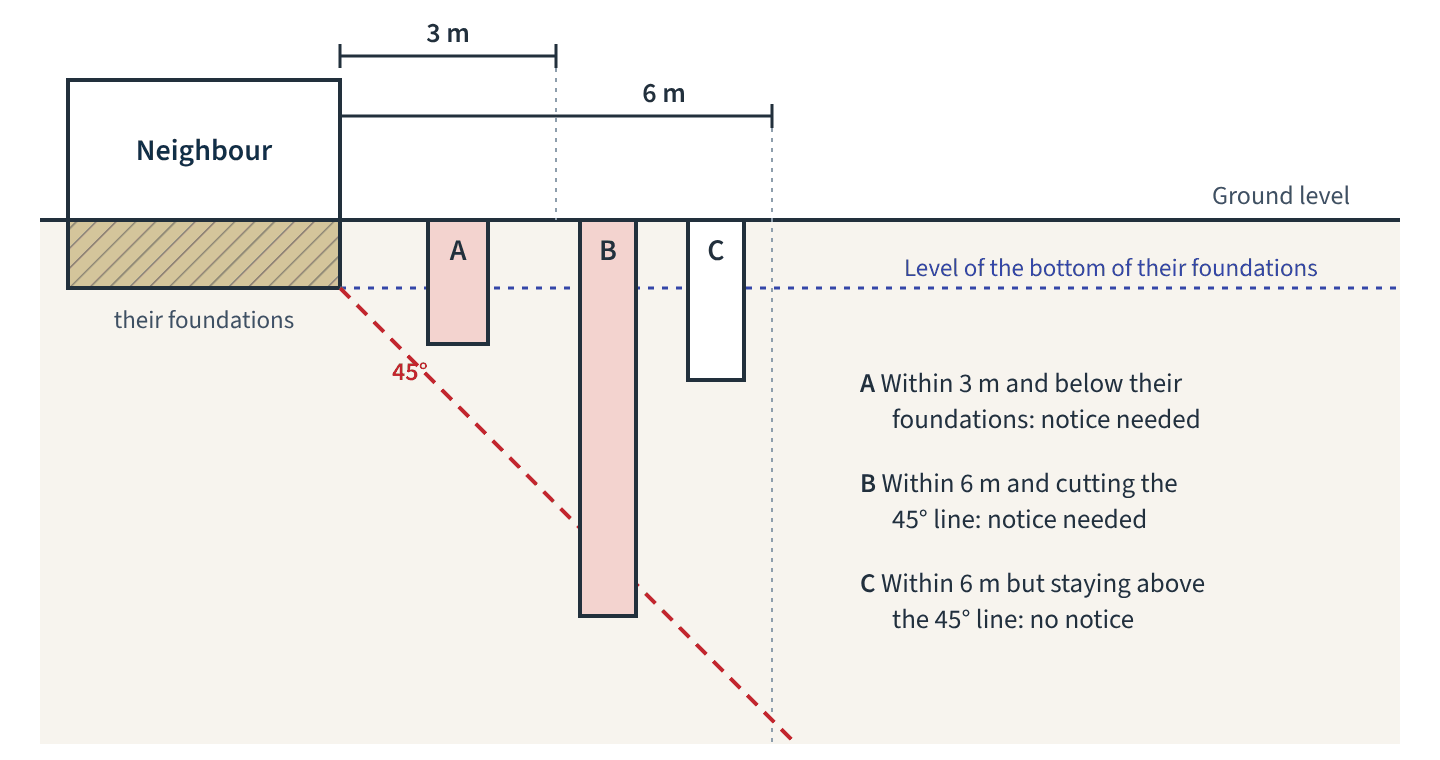
The Act applies if you dig within 3 metres of any building or structure next door and your dig goes below the bottom of its foundations.
Older houses often sit on shallow brick footings, sometimes well under a metre deep. Modern extension foundations commonly go deeper, so most extensions within 3 metres of next door are caught.
The 6-metre rule
The Act also applies if you dig within 6 metres and the excavation would cross a line falling away at 45 degrees from the bottom of the neighbour's foundations, towards your dig.
This catches deep work further away, such as basements, piling or deep drainage.
Examples
| Dig | Distance | Notifiable? |
|---|---|---|
| 1 m deep strip foundation, neighbour on shallow footings | 2 m | Usually yes, 3-metre rule |
| Same foundation | 5 m | Usually no |
| 3.5 m deep basement | 5 m | Usually yes, 6-metre rule |
| Shallow garden patio | 1 m | No, not deeper than their foundations |
The tricky bit: you rarely know how deep next door's foundations are
Without digging a trial hole you often cannot be certain. Surveyors usually assume typical footings for the age of the house, and a notice is often served on a precautionary basis. A trial pit can settle it.
Common questions
Does the 6-metre rule apply to a garden wall?
The rules apply to excavations near a building or structure belonging to the neighbour, which can include a garden wall.
Do piles count as excavation?
Boring for piles is excavation for these purposes, and deep piles often fall within the 6-metre rule.
Where this comes from in the Act
Links go to the official text of the Party Wall etc. Act 1996 on legislation.gov.uk.