
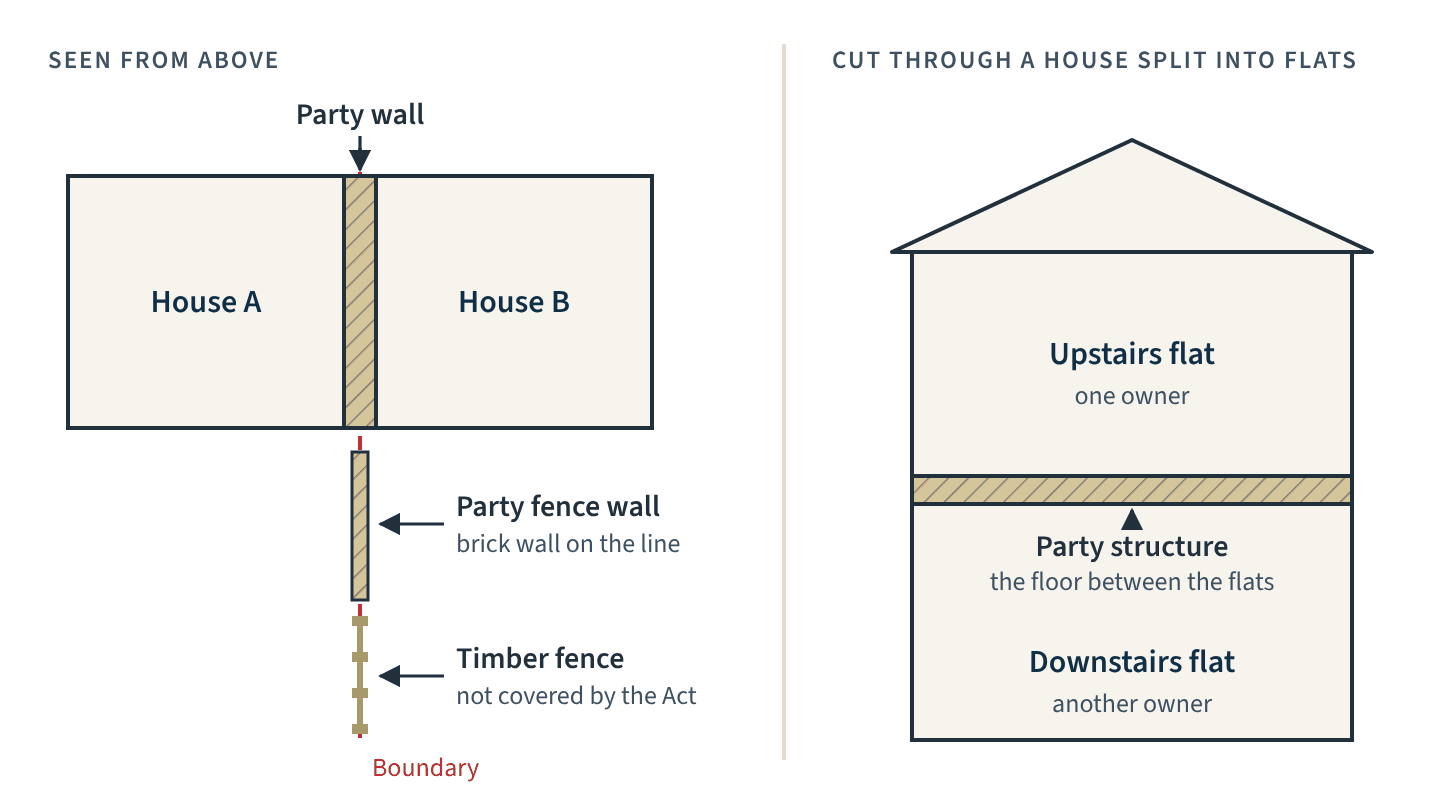
Party wall
There are two kinds:
- A wall that stands astride the boundary and forms part of a building. The wall between two terraced houses is the classic case.
- A wall that stands wholly on one owner's land but is used by both buildings to separate them. For example, where a neighbour has built their extension directly against your existing flank wall, that part of your wall can become a party wall.
Party fence wall
A masonry garden wall standing astride the boundary that is not part of a building. Brick and stone garden walls are often party fence walls. Timber fences are not, and neither is a wall built entirely on one side of the line.
Party structure
A wider term covering party walls and also floors, partitions or other structures separating buildings, or parts of buildings, that are reached by separate staircases or entrances. In a house converted into flats, the floor between the ground-floor flat and the one above is a party structure.
Why the label matters
If something is a party wall or party structure, each owner has rights over it and the Act sets out what can be done to it and how. Work to a party structure needs a party structure notice with two months' warning.
Quick examples
| Situation | Usually a party wall or structure? |
|---|---|
| Wall between two terraced houses | Yes, party wall |
| Brick garden wall on the boundary | Yes, party fence wall |
| Timber fence on the boundary | No |
| Floor between two leasehold flats | Yes, party structure |
| Neighbour's extension wall built against yours | Can be, for the part enclosed on both sides |
Where this comes from in the Act
Links go to the official text of the Party Wall etc. Act 1996 on legislation.gov.uk.